
Your Partner Won’t Get Rid of Anything. Before You Say Something, Read This.
When your partner won’t get rid of anything, the fight is rarely about the stuff. To you it’s a pile. To them it might be a memory, a backup plan, or proof they’re not wasteful. Don’t toss it behind their back and don’t ignore it forever. Agree on shared space first, talk about the space instead of the stuff, and let them make the calls on what’s theirs.
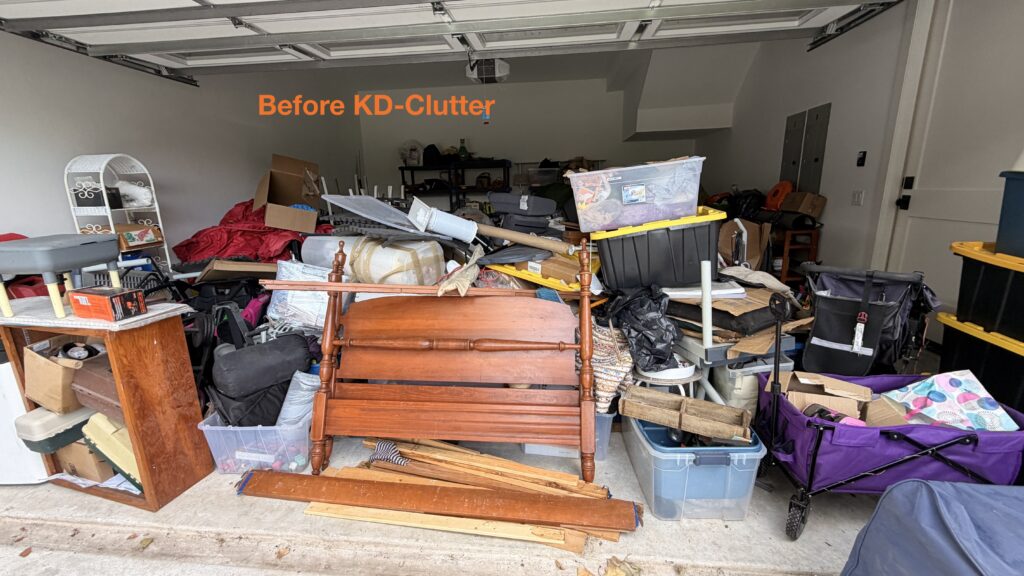
I walk into a lot of houses where one person wants the garage back and the other person is very attached to a box of cables from 2009. Nobody in that house is the villain. They just see the same pile in two totally different ways.
Not married? This works for anyone you share a roof with, your mom, your sister, your college roommate who swears that futon is coming back in style.
Why Won’t My Partner Get Rid of Anything?
Because to them, it isn’t junk. It’s doing a job.
Here are the jobs I see stuff doing most often:
- Memory keeper. The concert shirts, the kids’ art, the boxes from a parent who passed. Letting go feels like losing the person or the moment.
- Just in case insurance. The extra cords, the spare parts, the twelve empty jars. Usually comes from someone who grew up without much, where throwing things out felt reckless.
- Future self. The guitar they’re going to learn, the bike they’re going to ride, the jeans they’re going to fit back into.
- Money guilt. “I paid good money for that.” Tossing it feels like admitting the money was wasted.
- Out of sight, out of mind. Common with ADHD. Stuff stays out because putting it away means forgetting it exists. I broke that one down in my post on ADHD decluttering.
Once you know which job the stuff is doing, you stop arguing about the object and start dealing with the actual reason it’s still there.
Should You Just Clean It Up Yourself?
No. I know it’s tempting. I know they won’t notice half of it. Don’t.
Tossing someone’s things without asking almost always costs more than it saves. Even if they never miss the item, the day they find out, you’ve taught them their stuff isn’t safe around you. And people who feel like their stuff isn’t safe hold on tighter, not looser. You win one bag and lose the whole war.
The exception is actual trash and anything that’s a safety issue. Expired food, broken glass, a blocked exit. That’s not a negotiation.
Can You Just Ignore It and Keep the Peace?
For a little while, sure. Long term, it doesn’t work, it just goes quiet.
When your partner won’t get rid of anything and you say nothing, it usually turns into resentment that leaks out sideways. A sigh at the dining table. A comment about the garage at a family BBQ. A fight about dishes that’s really about the guest room you haven’t been able to use in two years. If the clutter bothers you enough that you’re thinking about it daily, it needs a real conversation, not a silent treatment with extra steps.
Where Do You Draw the Line When Your Partner Won’t Get Rid of Anything?
Draw it at shared space, not at their stuff.
Here’s the line I use with couples. Their personal space, like their side of the closet, their office, their workbench, is theirs to run however they want. Shared space, like the kitchen, the living room, the entry, and yes the garage where both cars are supposed to fit, gets decided together.
That one shift changes everything. You stop saying “your stuff is a problem” and start saying “I need the kitchen counter to work for both of us.” One feels like an attack. The other is just a household rule.
How Do You Bring It Up When Your Partner Won’t Get Rid of Anything?
How you start the conversation matters more than what you say in it. Research from The Gottman Institute found that the way a hard conversation starts usually predicts how it ends. Open with a jab and you’ll be fighting about the jab, not the garage.
A few rules that save marriages and garages:
- Pick your moment. Not when you’re tripping over the pile. Not when they just walked in from work. A calm Saturday morning, coffee in hand.
- Talk about you, not them. “I feel stressed when I can’t use the counter” beats “you never put anything away” every single time.
- Name one space, not the whole house. “Can we work on the entry together?” is doable. “This whole house is a disaster” is a declaration of war.
- Ask before you suggest. “What would make it easier to keep this clear?” Their answer is usually more useful than your plan.
- Leave the hardest stuff alone at first. The boxes from a parent who passed are not round one. Start with the easy wins.
How Do You Declutter Together Without Losing Your Mind?
When your partner won’t get rid of anything, go small, specific, and with limits you both agreed to before you start.
- Let the container be the bad guy. Pick one bin for their cords, their mugs, their shoes. When the bin is full, something has to go. Now it’s not you saying no, it’s the bin.
- Give them a maybe box. Anything they can’t decide on goes in a box with a date on it. If they don’t open it in 90 days, it leaves. Most of the time they forget what was in it.
- Photograph the memory. The old jersey can live in a photo album instead of the closet. Keep one great piece, not the whole collection.
- Show them where it’s going. “Donating” feels a lot easier when you know it’s landing with someone who’ll actually use it. That’s exactly why I started KD Discard and Donate.
- Build a system you’ll both keep. If only one of you can maintain it, it’s going to fall apart. I covered who’s on the hook for that in keeping your organizing system running.
And go one zone at a time. One drawer done together beats a whole garage done in a screaming match.
When Is It More Than Just Clutter?
Most of the time, a partner who won’t get rid of anything is just a person who keeps a lot. But sometimes it’s bigger than that.
If rooms can’t be used for what they’re meant for, if the thought of letting go of anything causes real panic, or if the stuff is creating health or safety risks, that may be hoarding disorder. That’s a real, diagnosable condition, and it needs a mental health professional, not a weekend purge. Pushing harder at home usually makes it worse. Getting the right support makes it better.
Frequently Asked Questions
Very normal. Clutter fights are usually about something underneath, like feeling unheard, stressed, or disrespected in your own home. Once you talk about that part instead of the pile, the stuff gets a lot easier to deal with.
Usually because the stuff is doing a job for them. It might hold a memory, act as just in case insurance, represent a future plan, or carry guilt about money spent. Figuring out which one helps you have a real conversation instead of an argument.
No. Tossing their things without permission breaks trust and usually makes them hold on even tighter. The only exceptions are real trash and safety hazards like expired food or a blocked exit.
Draw it at shared space. Their personal spaces are theirs to manage. Shared areas like the kitchen, living room, entry, and garage should be decided together, with clear limits you both agree on.
Pick a calm moment, talk about how the space affects you instead of what they’re doing wrong, focus on one area at a time, and ask what would make it easier for them. Start with easy wins, not sentimental items.
When every conversation turns into the same fight, or when you keep starting and stalling. A good organizer acts as a neutral third party, keeps decisions moving, and builds a system both of you can actually keep up with.
Usually not. Keeping a lot of stuff is common. If rooms can’t be used, letting go causes real distress, or the stuff creates safety or health risks, talk to a mental health professional, because hoarding disorder needs more than a cleanout.
Ready for a Neutral Third Party Who Isn’t Your Mother in Law?
Sometimes the best thing you can do for your relationship is let someone else be the referee. I come in with no side to take, no judgment, and no plans to toss anything without a yes. We make the decisions smaller, get the shared space working for both of you, and make sure the donations actually leave the house. Call me at 832-387-8355 or book your free consultation.
We work with families across Klein, Tomball, Hockley, The Woodlands, Spring, Cypress, Bridgeland, Katy, Conroe, Humble, Magnolia, and the Houston area.
KT Wood is the owner of KD Clutter, a home organizing and staging company based in Tomball, Texas. She’s a Certified Home Stager and TREC Certified Instructor serving Klein, Tomball, Hockley, The Woodlands, Spring, Cypress, Bridgeland, Katy, Conroe, Humble, Magnolia, and Houston.
Want a hand with this? See how my Professional Home Organizing service works, or book a free consult.