Your Clutter Isn’t Clutter. It’s Your Brain’s External Hard Drive.
ADHD decluttering feels harder because the stuff is often doing a job. When working memory drops things, the brain leans on objects as reminders, so the shirt holds the memory and the book holds the plan. Getting rid of it can feel like deleting a file. The fix isn’t forcing yourself to toss it. It’s moving what it was holding somewhere else first.
I have ADHD. I’m also a professional organizer. Yes, I see the irony, and yes, my junk drawer has opinions. So when a post went viral saying your clutter might be memory storage, I had a lot of feelings about it. Mostly, finally, somebody said it.
Why Is ADHD Decluttering So Much Harder Than It Looks?
Because you’re not just deciding about an object. You’re deciding about everything the object reminds you of.
For most people, getting rid of a sweater is a practical call. Does it fit? Do I wear it? Done. For an ADHD brain, that sweater might be the only thing reminding you about the trip, the person, or the version of you who was going to start running. Take it away and the reminder goes with it.
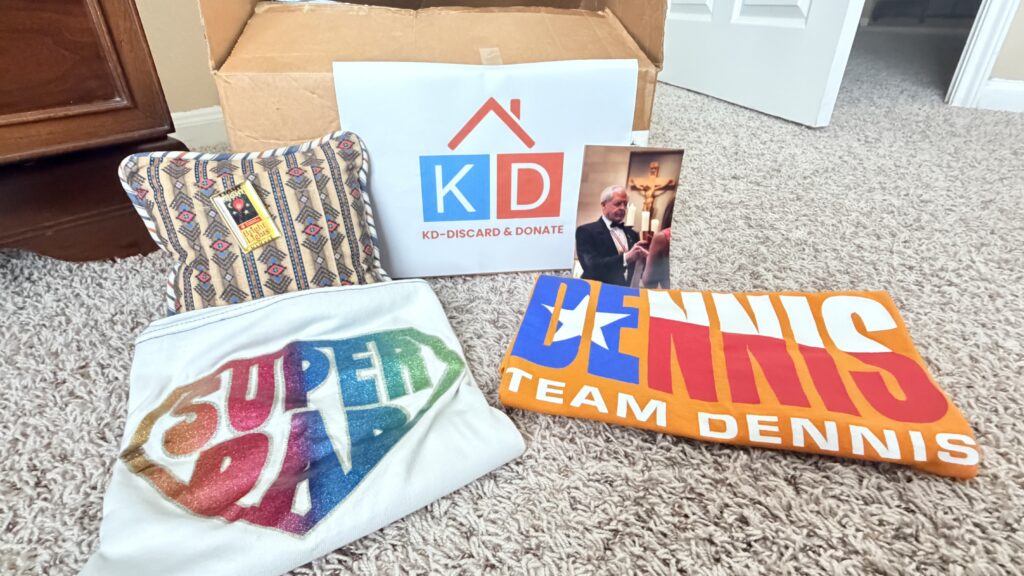
That’s why a “quick closet clean out” turns into two hours of sitting on the floor holding a concert tee. It’s not weakness. Your brain is trying to protect information it doesn’t trust itself to keep.
Is ADHD Decluttering Really About Hoarding?
No, and I want to say that loud for the people in the back. Most ADHD clutter is memory management, not a disorder.
Hoarding disorder is a real, diagnosable condition, and it’s a different animal. What most of my ADHD clients deal with is simpler. Things pile up because out of sight really is out of mind. So they keep stuff visible, and visible stuff multiplies.
If you’re worried it’s crossed that line, CHADD has a solid breakdown of organizing with ADHD and when to get extra support. Otherwise, go easy on yourself. You’re not broken. You’re resourceful, just with a lot of tote bags.
Why Does One Shirt Hold a Whole Memory?
ADHD memory tends to be associative and sensory. Instead of filing memories by date, the brain ties them to what you saw, touched, or wore at the time.
So the shirt from that summer isn’t just a shirt. It’s the retrieval button. Seeing it, touching it, or smelling it brings back something you might not be able to pull up any other way.
I learned this one the hard way after losing my dad. Sorting through his things, I realized I wasn’t attached to the stuff. I was scared that without it, I’d forget. That fear is real. However, the object and the memory are not the same thing, and that’s the good news.
What Kind of Stuff Are We Actually Talking About?
If you have ADHD, I bet at least one of these is in your house right now:
- A stack of books you’re definitely going to read
- Half used products, craft kits, or planners from three different “fresh starts”
- Clothes you haven’t worn but can’t donate
- Papers left out so you won’t forget to deal with them
- A random item in the corner that you know exactly why it’s there
Each one is holding something. A future version of you. A plan that never kicked off. A feeling you want to keep close. Once you see it that way, the pile stops looking like a character flaw, and ADHD decluttering stops feeling like a fight with yourself. And if the pile belongs to the person you live with, here’s what to do when your partner won’t get rid of anything.
Did Scientists Really Prove This?
Not exactly, and I’m not going to pretend otherwise. The viral post claimed scientists confirmed ADHD adults use objects as memory storage at far higher rates than everyone else. I went looking. That specific stat doesn’t have a study behind it.
Here’s what is real. Using outside things to remember stuff has a name, cognitive offloading, and everyone does it. Also, working memory struggles are a well known part of ADHD. Put those together and the idea makes a lot of sense. It just hasn’t been measured the way the post claimed. Either way, it changes how you should approach ADHD decluttering.
Bottom line, you don’t need a lab coat to confirm what you already live every day.
What Should You Ask Instead of “Does This Spark Joy?”
Skip the joy question. Honestly, half my stuff sparks mild guilt and it’s still here. Instead, ask these:
- What is this object holding for me?
- Is that information stored anywhere else I can get to?
- Can I photograph it, write it down, or save it somewhere so the object can go?
The goal isn’t to keep the object. The goal is to keep what it was storing. Once you move the memory, the plan, or the reminder somewhere safe, letting go gets a whole lot easier.
ADHD Decluttering Tips: How Do You Let Go Without Losing the Memory?
The best ADHD decluttering rule I know: move the information first, then move the object. Here’s how that looks in real life:
- Take a photo. Snap the kid’s art, the old concert tee, the gift you never used. Make an album called “Keeping this, not the stuff.”
- Write the note. If a book is holding a plan, write the plan down in your phone. Then the book can go.
- Keep one, not ten. Pick the single best item from a group and let the rest go.
- Give the plan a deadline. That craft kit gets 30 days. If it’s still in the box, it goes to someone who’ll use it.
- Know where it’s going. Donating feels better when you know your stuff is landing somewhere good. That’s exactly why I started KD Discard and Donate.
And once you’ve cleared the space, the system has to fit your brain, not a Pinterest board. I broke that down in who’s actually responsible for keeping your system running.
Frequently Asked Questions
Because objects often act as reminders when working memory is unreliable. Getting rid of an item can feel like losing the memory, plan, or feeling tied to it. That makes a simple decision feel much bigger than it is.
No. Hoarding disorder is a separate diagnosable condition. Most ADHD clutter comes from out of sight, out of mind thinking and using visible objects as reminders. If you’re unsure, talk to a mental health professional.
There’s no study proving ADHD adults do it at higher rates, despite what viral posts claim. However, cognitive offloading, using outside objects to remember, is well documented, and working memory challenges are a known part of ADHD.
Ask what the object is holding for you, whether that information lives anywhere else, and whether you can photograph it or write it down. If you can save what it holds, you can usually let the object go.
Go slow and start with the easy stuff, not the hardest box. Photograph items, keep a few meaningful pieces, and let the rest go to people who’ll use them. There’s no deadline on grief, and your house shouldn’t set one.
If you keep starting and stalling, bring in help. A good organizer keeps you moving, makes the decisions feel smaller, and builds a system that works with an ADHD brain instead of against it.
Build a system you can keep up on your worst week, not your best one. Keep important things visible, give every category an easy home, and do a quick weekly reset instead of a big monthly overhaul.
Ready to Clear the Space Without Losing What Matters?
If your stuff is holding more than you can sort through alone, that’s exactly what I’m here for. ADHD decluttering with me means no judgment, no tossing your life into a dumpster, and no “spark joy” lectures. Call me at 832-387-8355 or book your free consultation.
We work with families across Klein, Tomball, Hockley, The Woodlands, Spring, Cypress, Bridgeland, Katy, Conroe, Humble, Magnolia, and the Houston area.
KT Wood is the owner of KD Clutter, a home organizing and staging company based in Tomball, Texas. She’s a Certified Home Stager and TREC Certified Instructor serving Klein, Tomball, Hockley, The Woodlands, Spring, Cypress, Bridgeland, Katy, Conroe, Humble, Magnolia, and Houston.
Want a hand with this? See how my ADHD Strategic Organizing service works, or book a free consult.